SEO vs. Paid Ads: Strategies for Clinics and Medical Centers
You need to boost traffic to your website, but what strategy will you follow?
→ Pay-per-click advertising (PPC) or search engine optimization (SEO)?
What's the difference, and which one is better?
The goal of this post is to unveil the advantages and disadvantages of each strategy so that, after analyzing the information, you can make the best decision for your brand.
You already know that at Medical Marketing, we can assist you with everything related to marketing in the healthcare sector.
That being said, let's get started!
Paid Ads or PPC (Pay-Per-Click)
With pay-per-click advertising, you pay for ad space on search engine results pages.
These are the ads you can see at the top and right-hand side of Google, Bing, and other search engine results pages.
Let's look at an example of paid ads that most of us engage with at least once a year:
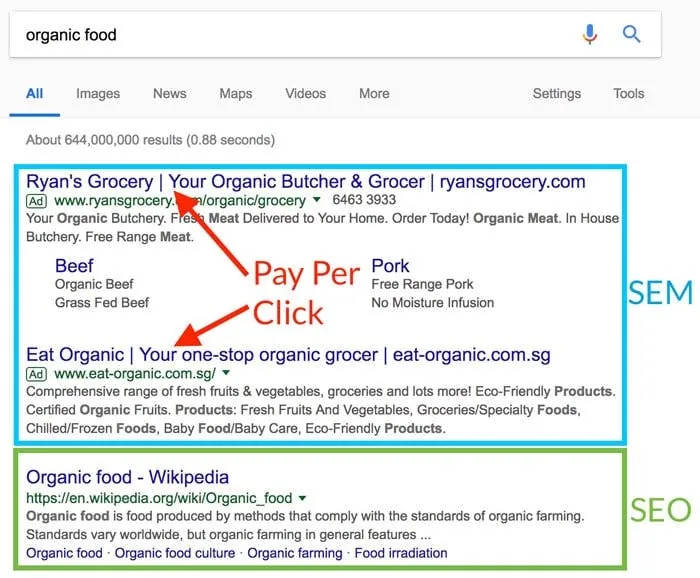
In your case, the ads will be targeted towards keywords related to health services or medical care that your audience searches for online.
These carefully crafted ads link directly to your website.
And here's the best part: you only pay when someone clicks on your ad.
By setting up a paid search campaign, for instance, with Google Ads, you bid on the keywords you're interested in, competing for the coveted top spots in search results.
You can set your budget and the amount of money you're willing to bid for each click on each of the keywords you want to bid on.
Essentially, you're participating in a digital auction for visibility.
Advantages of paid ads in the medical sector
- PPC or paid search is a quick way to drive traffic to your website by placing your ad on the first page of search results.
For this, it's important to bid enough and create an ad with relevant and engaging content.
✔ This type of advertising is ideal for gaining exposure when your website is new.
- You only pay if someone clicks on your ad.
- If your marketing budget is at least €40 per day, you can achieve a good return on investment (ROI).
This €40 amount may vary depending on the medical market you target, competition, among other factors.
Our recommendation is that if you decide to employ this strategy, prepare a reasonable budget to achieve good results.
- You have the ability to target your ads to your target audience.
This ensures that your ads are only shown to people making inquiries directly related to the medical or aesthetic service your clinic offers.
Your ads can also appear in specific locations, days, and times.
- The data from your paid search campaigns will be very useful for your marketing efforts.
You can test and make changes to your marketing campaign quickly and easily.
Disadvantages
- If you don't have a high enough budget, your Google Ads campaigns may not produce the results you expected.
- Not all people who click on your ad will become new patients. Some will click on the ad, browse your website, and then leave.
- Once you finish your paid search campaign, the traffic you were receiving will stop.
- There is a learning curve. You may need to try different things and adjust the campaign for a while until you find what works for your specific clinic.
→ Some areas and keywords can be very competitive, and the average cost per click (what you pay for each click on average) can be really high.
For example, if your clinic is in a large city, like Barcelona or Madrid, a relatively general term or keyword like "sports medicine" will have a lot of competition. This means you'll have to bid higher to start seeing a return on investment.
SEO - Search Engine Optimization for Clinics
The goal of SEO is to increase your website's ranking in organic search results, instead of paying for ads.
For a clinic or any medical or health practice in general, this means creating customized content for your website based on the keywords you want to target or position.
Essentially, you should be able to explain the services you provide and the procedures you perform in a way that your patients can easily understand.
Not only does it demonstrate what sets you apart from all your competitors, but it also provides useful information that allows potential patients to make an informed decision about your medical care.
Advantages of SEO for clinics and medical offices
- Unlike pay-per-click advertising, SEO doesn't have to be a continuous process.
It's highly recommended to perform SEO-oriented content periodically to ensure you stay up to date with the constant changes in search engines, but you don't necessarily have to maintain SEO efforts throughout the year to see a return on your investment.
- Medical SEO tends to offer much better medium to long-term results for your clinic than paid search (PPC).
Partly because customized content remains on your website, you can continue to reap benefits long after it's published.
With good SEO, this benefit can extend for years.
- Data suggests that patients are more likely to trust you if they find you through organic search results, rather than ads.
Patients want to find the information they need without feeling like you're trying to sell them, even though this is often the goal.
- People often ignore ads on search engine results pages, focusing instead on organic results.
- SEO for your clinic is ultimately more cost-effective than paid search.
Disadvantages of SEO for clinics
- SEO is a long-term investment, meaning you won't get instant results like you would with a paid search or PPC campaign.
It will take time to get search engines to recognize your content and position your clinic.
- Search engines often change their algorithms, which can affect your rankings on Google, Bing, etc.
So, you must review and adjust your content and SEO efforts periodically to ensure you don't lose positions in the ranking.
- In highly competitive areas and in highly demanded health sectors, it can be really challenging to even get within the top 10 positions in organic searches.
SEO vs. PPC in the Medical Sector
Now, if your budget allows it... why not apply both strategies?
Both paid search and SEO have pros and cons, but if you combine both in your digital marketing strategy for clinics, you'll have the best of both worlds.
Paid search is an excellent way to quickly and easily attract traffic to your website.
→ It gets your website moving when you're starting with your clinic or center.
On the other hand, SEO can offer more lasting results and more qualified leads (actively seeking your services).
Both marketing techniques can complement each other; however, budget limitations sometimes prevent running ad campaigns and SEO simultaneously.
If this is your case, evaluate, along with your medical marketing team, the advantages and disadvantages of each in relation to your clinic's needs.
→ The strategy that best helps you at this moment is the one you should prioritize.
———
After understanding better the differences and how paid searches and organic SEO can contribute to your clinic.
How do you plan to allocate your marketing budget?
You don't have to answer right now, but what you can do is schedule a free strategic session with our experts.
Frequently asked questions
What is the main difference between SEO and paid ads (PPC) for a clinic?
With paid ads you pay for placement at the top of search results and only when someone clicks, so traffic starts quickly but stops when the campaign ends. SEO works to rank your site organically over time, and its content keeps attracting visitors long after publication. In short, PPC buys immediate visibility while SEO builds lasting presence.
Which strategy delivers faster results for a new clinic?
Paid search is the faster option because your ad can appear on the first page as soon as the campaign is live, which is useful when your website is new and has little organic authority. SEO typically takes months for search engines to recognise and rank your content. Many clinics start with PPC while building SEO in parallel.
Is SEO or paid advertising more cost-effective in the long run?
Over the medium to long term, SEO tends to be more cost-effective because custom content stays on your site and can keep generating visits for years without ongoing ad spend. Paid ads require continuous budget to maintain traffic. That said, the best choice depends on your goals, competition and available budget.
Should a clinic use both SEO and paid ads at the same time?
If the budget allows, combining both gives you the immediate traffic of paid search and the durable, more qualified visibility of SEO. When funds are limited, it is worth prioritising the strategy that best fits your current needs alongside your marketing team. Highly competitive specialties and large cities may make one channel more demanding than the other.